A. Life
Improvement Program (LIP) in the Philippines
Poverty reduction is
one of the main goals of the Philippine government. Majority of the population
lives in the rural areas and this population depends on agriculture as the main
source of livelihood. In this scenario, Rural Life Improvement (LIP) approach
can be an innovative approach to poverty reduction. The notable case of LIP
approach in the Philippines is the Training Services Enhancement Project for
Rural Life Improvement (TSEP-RLI) in the Province of Bohol. The project was
jointly conducted by the Government of the Philippines thru Department of
Agriculture (DA) – Agricultural Training Institute (ATI) and Japan
International Cooperation Agency (JICA).
The target
beneficiaries are farmers, fisher folk, women, youth and extension workers. The
ATI- DA provides training services to the target beneficiaries as way to
improve human resource development. The main components of the project are:
improvement rural living condition, environment preservation and livelihood projects. The project utilized the idea of participatory development in order
to achieve the goals for the target beneficiaries; local government units and
other stakeholders were involved from project planning to implementation.
According to Fermentira (2005) the project have positive impacts to the
community such as: community mobilization and social participation, greater
food sufficiency and stable price, increased income and employment generation,
served as a model for other municipalities, and strengthened the partnership
between the various stakeholders involved.
B. What are the
advantages and disadvantages of Life Improvement Program approach?
1) Advantages
The advantages of the
approach are that the target beneficiaries are empowered and their
self-reliance is developed. According to experts, projects using participatory
approach have higher success compared to top-down approach.
LIP approach is
holistic in tackling poverty issues. It concerns income generating activities
but also inculcate awareness of environmental protection to the people.
There is also
cost-sharing and collaboration among the stakeholders in this way the
responsibility and accountability for the success and failure of the project is
shared among the stakeholders.
2) Disadvantages
One stumbling block to
this approach is how to motivate the different stakeholders to cooperate in the
project. For the project to be successful there should be a harmonious mix of
government, aid agencies, target beneficiaries and other stakeholders.
The other main
disadvantage in my point of view is the sustainability of these projects after
the funding agency have concluded the project and it’s time to pull-out from
the project area. If the target beneficiaries is not self-motivated enough and
the trainings have not been internalize by the people to the point that it is
really beneficial to them. Examples are cases of low level of participation by
the project beneficiaries like attending meetings just to comply with the
attendance and not really deeply involved in the discussion where one’s
critical mind is opened-up.
References:
Case study of
applied LIP approach/activities in the Philippines: the training services
enhancement project for rural life improvement (TSEP-RLI) experience.
URL: http://www.eldis.org/static/DOC20320.htm
FEMENTIRA, Graciana B.
Case Study of Applied LIP Approach/Activities in the Philippines The
Training Services Enhancement Project for Rural Life Improvement (TSEP-RLI)
Experience. Agricultural Training Institute (ATI) -VII - Central Visayas
Tagbilaran City, Bohol, Philippines.
REYES, Celia M. and
Lani E. Valencia. Poverty Reduction Strategy and Poverty Monitoring:
Philippine Case Study.
URL:http://siteresources.worldbank.org/INTPAME/Resources/Country-studies/philippines_povmonitoring_casestudy.pdf
Before international non-governmental organizations were established to reduce poverty or the Millennium Development Goals was formulated, and poverty subjects are taught in universities. Poverty is already a concern of Mallanaga Vātsyāyana, an Indian philosopher who lived in 4th century AD. He wrote in his book Kama Sutra that “poverty is not a virture. It is an obstacle, not only to pleasure but also to ethics and virtue. Morality is a luxury which very poor people can rarely afford.” This means poverty is a condition that limits your freedom. Where most people want to escape. And it has many dimensions.
Poverty has different meaning to people. UNDP introduced the concept of human poverty. UNDP’s definition of poverty is not the sum total of well being; lack of income cannot be the sum of poverty. Human poverty does not focus on people do or do not have, but on what they can or cannot do (UNDP, 2000). According to World Bank (2006), poverty is hunger. Poverty is lack of shelter. Poverty is being sick and not being able to see a doctor. Poverty is not having access to school and not knowing how to read. Poverty is not having a job, is fear for the future, living one day at a time. Poverty is losing a child to illness brought about by unclean water. Poverty is powerlessness, lack of representation and freedom.
Extreme poverty was defined by World Bank as living on less than US$ (PPP) 1 per day, and moderate poverty as less than $2 a day. It has been estimated that in 2001, 1.1 billion people had consumption levels below $1 a day and 2.7 billion lived on less than $2 a day. The proportion of the developing world's population living in extreme economic poverty has fallen from 28 percent in 1990 to 21 percent in 2001.
There is a principle that states that: what you cannot measure, you cannot manage. Therefore, to reduce poverty it has to be defined and measured using different indicators to capture its multidimensional facets. The indicators should include economic, social and political needs. These indicators should evolve to capture the changing concepts of poverty in changing times.
The most commonly used poverty measurement is measure of relative income. Relative poverty views poverty as socially defined and dependent on social context. It is a set standard which is consistent over time and between countries. A relative measurement could be used to compare the total wealth of the poorest one-third of the population with the total wealth of richest 1% of the population. Gini coefficient is one of the several income inequality metrics. In many developed countries the official definition of poverty used for statistical purposes is based on relative income. As such many critics argue that poverty statistics measure inequality rather than material deprivation or hardship (Wikipedia). -Rico Buraga at http://emarketingconsult.com/blog/
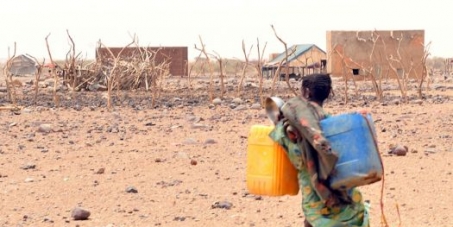
18 million people are desperate for food in Africa's drought-struck Sahel, but urgent appeals for help are being met with deafening silence by governments worldwide. Senegalese musician Baaba Maal has started a petition to get the US, Japan, France and Germany to pledge their fair share of aid. Let's join him -- sign the urgent petition below and sound the massive alarm needed to shake these leaders into action:
My name is Baaba Maal, and I'm a Senegalese musician writing with a personal plea for help. I live in Africa's drought-struck Sahel region where 18 million people are on the brink of disaster, including 1 million children at risk of starvation. But our urgent appeals for help are being met with deafening silence. Only a targeted and overwhelming demand for action can stop this catastrophe from turning deadly.
The UN says millions of lives could be destroyed unless $1.5 billion in aid is channeled in immediately, but governments have pledged less than half the required sum. The countries who can make all the difference are the US, Japan, France and Germany, but they're stalling -- that's why I started a petition on Avaaz's Community Petitions website to appeal to the world for help.
In days, world leaders will gather in Brussels to discuss the Sahel -- if they decide right there and then to pledge their fair share, we can avert disaster. Sign this urgent petition now -- Avaaz, Africans Act 4 Africa, and Oxfam will deliver it in a coordinated stunt when we reach 1 million signatures:
Terrible drought, political unrest, and sky high food prices have wreaked havoc on an area the size of the US, stretching from Senegal in the west all the way to Sudan in the east. People here are doing everything they can to survive, but the crisis has hit so hard that it's difficult to stay hopeful. I've seen women and children trying to grow food in patches of land that are bone dry. They know that people are talking about what is happening in the Sahel, but they don't know if aid will ever arrive.
The UN has only received 43 percent of the $1.5 billion needed -- it's a shortfall of gargantuan proportions. But this gap must be filled, and can be filled by the world's richest countries, if there's political will. We don't have much time to avert mass suffering, and I'm determined to speak on behalf of the people here until they get the help they need.
The world has turned a blind eye to crises like this before, but this time we can make the difference between life and death by forcing our governments to respond. Sign this urgent petition now:
Avaaz members have come together time and time again to respond to natural disasters, saving thousands of lives by ensuring that crucial aid was delivered to Burma, Haiti, Somalia and Pakistan. We have the power to force our leaders to stop idling away in the face of a crisis we can prevent. Let's stand together now to demand that the world respond to the pleas of the millions living in the vast Sahel region.
The
information contained herein is provided as a public service with the
understanding that this site makes no warranties, either expressed or implied,
concerning the accuracy, completeness, reliability, or suitability of the
information. Nor does warrant that the use of this information is free of any
claims of copyright infringement. This site do not endorse any commercial
providers or their products.
Rico BURAGA blog: To make random
reflections on random subjects including the subject of randomness itself.
2005- 2014 All Rights Reserved. Rico BURAGA Blog
http://ricoburaga.blogspot.com
rico, buraga, rico buraga, philippines, metro manila, quezon
city, emarketing specialist, e-marketing,
specialist, consultant, digital marketing, marketing, online, internet, seo,
online advertising, ethical hacking, web, analytics, blogger, blogging, business
blogging, multi-channel, ushahidi, magento, moodle, apps, google apps, civicrm,
website optimizer, negative campaigning, economics, price analysis, agricultural
economics, feasibility study, project, project development, development
management, international development, management, ict4d, crisis mapping,
digital, social, media, social media, personal blog, networking, emarketing, cro,
website usability, user experience, ux, conversion rate optimization,
copywriting, optimization, conversion rate, outsource,
outsourcing, freelance, digital marketing engineer, inbound marketing, demand
generation, web analytics, google analytics, search engine, ubuntu, web
copywriting, adwords, google adwords, certified,
email marketing, uplb graduate, nagoya university graduate, gsid, idmg, uplb,
wordpress, joomla, drupal, strategy, content, filipino, professional, google,
microsoft, pay per
click, search analytics, retargeting, e-commerce, autodidactic, bibliophile. ceh ver6., idpa
shooter, shotokan karate, zen practitioner, project lead, united states of
america, united states, new york, los angeles, england, united kingdom, canada,
australia, ireland, south africa, new zealand, cebu, singapore, india, hong kong,
puerto rico, nigeria, india, pakistan, russia, china, brazil, saudi arabia,
japan, malaysia, germany, munich, dubai, italy, canberra, ghana, berlin, texas,
dallas, arizona, boston, uae, ricoburaga.com, ricoburaga.net mobile
marketing association, web marketing association, american marketing
association, direct marketing association, chartered institute of marketing