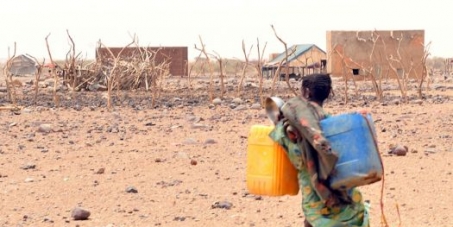
18 million people are desperate for food in Africa's drought-struck Sahel, but urgent appeals for help are being met with deafening silence by governments worldwide. Senegalese musician Baaba Maal has started a petition to get the US, Japan, France and Germany to pledge their fair share of aid. Let's join him -- sign the urgent petition below and sound the massive alarm needed to shake these leaders into action:
My name is Baaba Maal, and I'm a Senegalese musician writing with a personal plea for help. I live in Africa's drought-struck Sahel region where 18 million people are on the brink of disaster, including 1 million children at risk of starvation. But our urgent appeals for help are being met with deafening silence. Only a targeted and overwhelming demand for action can stop this catastrophe from turning deadly.
The UN says millions of lives could be destroyed unless $1.5 billion in aid is channeled in immediately, but governments have pledged less than half the required sum. The countries who can make all the difference are the US, Japan, France and Germany, but they're stalling -- that's why I started a petition on Avaaz's Community Petitions website to appeal to the world for help.
In days, world leaders will gather in Brussels to discuss the Sahel -- if they decide right there and then to pledge their fair share, we can avert disaster. Sign this urgent petition now -- Avaaz, Africans Act 4 Africa, and Oxfam will deliver it in a coordinated stunt when we reach 1 million signatures:
Terrible drought, political unrest, and sky high food prices have wreaked havoc on an area the size of the US, stretching from Senegal in the west all the way to Sudan in the east. People here are doing everything they can to survive, but the crisis has hit so hard that it's difficult to stay hopeful. I've seen women and children trying to grow food in patches of land that are bone dry. They know that people are talking about what is happening in the Sahel, but they don't know if aid will ever arrive.
The UN has only received 43 percent of the $1.5 billion needed -- it's a shortfall of gargantuan proportions. But this gap must be filled, and can be filled by the world's richest countries, if there's political will. We don't have much time to avert mass suffering, and I'm determined to speak on behalf of the people here until they get the help they need.
The world has turned a blind eye to crises like this before, but this time we can make the difference between life and death by forcing our governments to respond. Sign this urgent petition now:
Avaaz members have come together time and time again to respond to natural disasters, saving thousands of lives by ensuring that crucial aid was delivered to Burma, Haiti, Somalia and Pakistan. We have the power to force our leaders to stop idling away in the face of a crisis we can prevent. Let's stand together now to demand that the world respond to the pleas of the millions living in the vast Sahel region.
Today another 27 children's bodies were found massacred in Syria. India and the US can cut off the arms supply to Syria's brutal regime by threatening to boycott Syria's main weapons supplier, Russian arms company Rosoboronexport. This financial pressure could end the massacres. Sign the petition now to stop Russia's deadly supply to Syria!
Today another 27 children's bodies were found massacred in Syria. To stop this horror, we need to cut off the flow of arms to the regime. There is one way to do it, but it's going to take all of us working together to make it happen.
Here's how: India and the US are key clients to Syria's main weapons supplier -- the state-owned Russian company Rosoboronexport. If we can get the two countries to threaten to halt all deals unless the Russians stop supporting Syria's murder machine, the arms dealers could be forced to stop their Syria sales. Both the US and India want to stop the violence in Syria, but diplomacy is failing. This is their best chance -- let's give them a massive mandate to act.
The US has already persuaded the company to stop light weapons sales to Syria. Now if we can build up the pressure on India and get both countries to speak out, Rosoboronexport could be forced to cut Syria's arms supply completely. Click here to sign the urgent petition to stop dealing death to Syria and tell everyone -- our call will be delivered to both countries and Rosoboronexport at a massive arms fair in Paris in 3 days:
International political solutions are failing to stop the bloodshed in Syria -- just last week the world was stunned by the brutal al Houla massacre where 49 children were executed, and today there is another mass killing. Why? Assad is protected by his old friend Russia, which has blocked international action while profiting in arms sales -- Rosoboronexport is Russia's biggest arms dealer, bringing the government billions in revenue per year. President Assad is only clinging to power through military might and sowing fear. If we can convince Russia that supporting the Syrian regime is not worth it, and end arms sales to Assad, his killing arsenal will wane and his command will slip away.
India and the US make up over 50% of Russia's arms sales, and they both want strong action on Syria. The US has led efforts to stop the violence, and a group of US Senators is right now calling on the Pentagon to cancel a massive helicopter contract with Rosoboronexport. India already voted to stop the violence in Syria at the UN Security Council. Now, experts say if there's even a hint that the Indian government might reconsider its patronage of Rosoboronexport because of Syria, sales to the regime could end, and the Russians could ditch their support for Assad.
Rosoboronexport could be held legally responsible for war crimes for sending weapons to the Syrian regime, but due to huge profits and a sense of impunity, they continue their bloody business as usual. Diplomatic pressure is mounting on Russia right now, but it is this financial threat that could be the deciding card. We have to act now and make sure hundreds of thousands of us speak out before Rosoboronexport arrives in Paris next week. Click to call on the US and India to stop Russia's deadly deals now and forward to everyone:
Over the past year, Avaaz members have supported the Syrian spring and an end to the violence -- we have broken the blackout, exposed hidden atrocities and provided critical lifelines to Syrians under siege. Today we are delivering our petition to the UN to call for more monitors. Now, let's do all we can to cut off the weapons at the source that are killing the Syrian people.
With hope and determination,
Alice, Joseph, Denis, Luca, Alice, Emma, Ricken, Stephanie, Wissam, Dalia and the entire Avaaz team
1. Severitylooks at the scope and intensity of an attack. Analysis under this criterion examines the number of people killed, size of the area attacked, and amount of property damage done. The greater the damage, the more powerful the argument becomes for treating the cyber attack as an armed attack.
2. Immediacylooks at the duration of a cyber attack, as well as other timing factors. Analysis under this criterion examines the amount of time the cyber attack lasted and the duration of time that the effects were felt. The longer the duration and effects of an attack, the stronger the argument that it was an armed attack.
3. Directnesslooks at the harm caused. If the attack was the proximate cause of the harm, it strengthens the argument that the cyber attack was an armed attack. If the harm was caused in full or in part by other parallel attacks, the weaker the argument that the cyber attack was an armed attack.
4. Invasivenesslooks at the locus of the attack. An invasive attack is one that physically crosses state borders, or electronically crosses borders and causes harm within the victim-state. The more invasive the cyber attack, the more it looks like an armed attack.
5. Measurabilitytries to quantify the damage done by the cyber attack. Quantifiable harm is generally treated more seriously in the international community. The more a state can quantify the harm done to it, the more the cyber attack looks like an armed attack. Speculative harm generally makes a weak case that a cyber attack was an armed attack.
6. Presumptive legitimacyfocuses on state practice and the accepted norms of behavior in the international community. Actions may gain legitimacy under the law when the international community accepts certain behavior as legitimate. The less a cyber attack looks like accepted state practice, the stronger the argument that it is an illegal use of force or an armed attack.
See Schmitt, supra note 16, at 913–15; see also Wingfield, T. 2000. The Law of Information Conflict: National Security Law in Cyberspace. Ageis Research Corp. 124–27 (examining Schmitt’s use of force analysis).
The
information contained herein is provided as a public service with the
understanding that this site makes no warranties, either expressed or implied,
concerning the accuracy, completeness, reliability, or suitability of the
information. Nor does warrant that the use of this information is free of any
claims of copyright infringement. This site do not endorse any commercial
providers or their products.
Rico BURAGA blog: To make random
reflections on random subjects including the subject of randomness itself.
2005- 2014 All Rights Reserved. Rico BURAGA Blog
http://ricoburaga.blogspot.com
rico, buraga, rico buraga, philippines, metro manila, quezon
city, emarketing specialist, e-marketing,
specialist, consultant, digital marketing, marketing, online, internet, seo,
online advertising, ethical hacking, web, analytics, blogger, blogging, business
blogging, multi-channel, ushahidi, magento, moodle, apps, google apps, civicrm,
website optimizer, negative campaigning, economics, price analysis, agricultural
economics, feasibility study, project, project development, development
management, international development, management, ict4d, crisis mapping,
digital, social, media, social media, personal blog, networking, emarketing, cro,
website usability, user experience, ux, conversion rate optimization,
copywriting, optimization, conversion rate, outsource,
outsourcing, freelance, digital marketing engineer, inbound marketing, demand
generation, web analytics, google analytics, search engine, ubuntu, web
copywriting, adwords, google adwords, certified,
email marketing, uplb graduate, nagoya university graduate, gsid, idmg, uplb,
wordpress, joomla, drupal, strategy, content, filipino, professional, google,
microsoft, pay per
click, search analytics, retargeting, e-commerce, autodidactic, bibliophile. ceh ver6., idpa
shooter, shotokan karate, zen practitioner, project lead, united states of
america, united states, new york, los angeles, england, united kingdom, canada,
australia, ireland, south africa, new zealand, cebu, singapore, india, hong kong,
puerto rico, nigeria, india, pakistan, russia, china, brazil, saudi arabia,
japan, malaysia, germany, munich, dubai, italy, canberra, ghana, berlin, texas,
dallas, arizona, boston, uae, ricoburaga.com, ricoburaga.net mobile
marketing association, web marketing association, american marketing
association, direct marketing association, chartered institute of marketing